The Multi-Agent Trap: Why Most Teams Add Agents Too Early
LangChain's architecture guide reveals four patterns for multi-agent systems. But the real insight? You probably don't need them yet.
The Silicon Quill
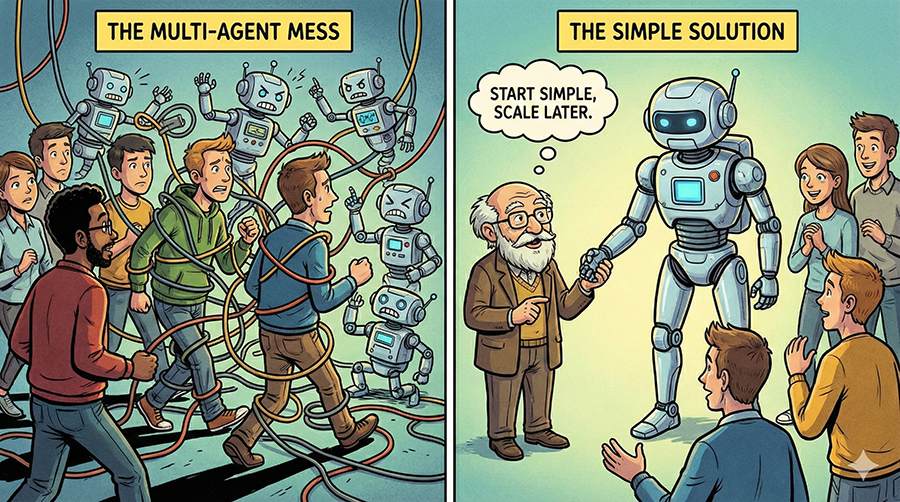
Here’s the most important sentence from LangChain’s new architectural guide on multi-agent systems:
“Start with a single agent and good prompt engineering. Add tools before adding agents. Graduate to multi-agent patterns only when you hit clear limits.”
Read that again. The company whose entire business model depends on people building complex agent architectures is telling you to start simple and stay simple as long as possible.
That’s either refreshingly honest or a sophisticated trust-building strategy. Either way, the advice is sound.
The Premature Multi-Agent Problem
There’s a pattern I’ve seen repeatedly in agent development. A team builds a working single-agent system. It handles their use case reasonably well. Then someone reads about multi-agent architectures and decides they need one.
Three months later, they have:
- Multiple agents that spend more time coordinating than working
- Debug sessions that require tracing messages across agent boundaries
- A system that’s slower, more expensive, and harder to modify than the original
- No clear improvement in output quality
Multi-agent architectures solve real problems. But they solve specific problems, and most teams don’t have those problems yet.
When You Actually Need Multiple Agents
LangChain identifies two primary constraints that push you toward multi-agent systems:
Context management - A single agent’s context window can only hold so much. When your task requires more information than fits in context, you need some way to distribute knowledge across multiple agents.
Distributed development - When different teams own different parts of the system, having separate agents with clear boundaries makes ownership easier to manage. This is an organizational problem, not a technical one, but it’s real.
Notice what’s not on this list: “It would be cool” or “Our competitors are doing it” or “The architecture diagram looks more impressive.”
If you’re not hitting context limits and you don’t have team ownership boundaries to respect, a single well-designed agent is probably better than a multi-agent system.
The Four Patterns
When you do need multiple agents, LangChain outlines four distinct architectural patterns. Choosing the right one matters.
Subagents: Centralized Orchestration
A primary agent delegates to specialized subagents for specific domains. Think of a project manager handing tasks to specialists.
Best for: Tasks requiring expertise across multiple domains that need coordination. A research agent that delegates to a web search agent, a document analysis agent, and a summarization agent.
Watch out for: The orchestrator becoming a bottleneck. If every decision routes through one agent, you’ve just created a single point of failure that’s harder to debug than a simpler system.
Skills: Progressive Disclosure
A single agent dynamically loads specialized knowledge as needed. Instead of multiple agents, you have one agent with modular capabilities.
Best for: When different tasks require different knowledge but not truly parallel work. A coding agent that loads language-specific context based on what file you’re working in.
Watch out for: Context pollution. Loading multiple skill modules can fill up context with information that’s not relevant to the current step.
Handoffs: State-Driven Transitions
Agents pass control to each other in sequence, with clear transition points. Like an assembly line where each station performs one operation.
Best for: Sequential workflows where each stage has distinct requirements. Customer service that escalates from a triage agent to a specialist agent to a resolution agent.
Watch out for: State management between handoffs. If the receiving agent doesn’t have the context it needs, you get degraded performance or outright failures.
Router: Parallel Dispatch
Incoming requests get classified and sent to the appropriate specialized agent. Multiple agents can work in parallel on their respective domains.
Best for: High-volume systems where different request types benefit from different handling. A support system that routes billing questions to one agent and technical questions to another.
Watch out for: Classification accuracy. If the router sends requests to the wrong agent, everything downstream fails. You’ve centralized failure in a different place.
The Performance Reality
LangChain’s data shows that stateful patterns save approximately 40% on subsequent calls. That’s substantial, but it comes with asterisks.
First, “subsequent calls” matters. If your usage pattern is mostly one-shot requests, stateful architectures don’t help. You’re paying the complexity cost without the performance benefit.
Second, the 40% savings assumes you’ve implemented state management correctly. Getting state handling wrong can actually make things slower as agents spend time reconciling inconsistent state.
Third, these savings compound with good caching strategies but don’t replace them. A single agent with good caching often beats a multi-agent system with poor caching.
The Decision Framework
Before adding agents, ask these questions:
Is my single agent hitting context limits? If you can fit all necessary information in context and the agent performs well, you don’t have a multi-agent problem.
Would adding a tool solve my problem? Tools are simpler than agents. A single agent with a new tool is easier to build, debug, and maintain than two coordinating agents.
Can I clearly define the boundary between agents? If you can’t articulate exactly where one agent’s responsibility ends and another’s begins, you’re not ready for multi-agent architecture.
Do I have the observability infrastructure? Multi-agent systems require tracing across agent boundaries. If you can’t see what’s happening, you can’t fix what breaks.
Is coordination overhead justified by capability gain? Every message between agents costs time and money. The distributed system needs to provide enough value to offset that cost.
If you answered “no” to any of these, stay with a single agent and keep iterating on prompts and tools.
Common Mistakes
Adding agents instead of improving prompts. A poorly prompted single agent won’t be saved by becoming a poorly prompted multi-agent system. The bad prompts will propagate, and you’ll have more of them.
Splitting for theoretical purity. “These are logically separate concerns” doesn’t mean they need separate agents. Logical separation can exist in prompts and tools without architectural separation.
Underestimating coordination cost. Every time agents communicate, there’s latency, token cost, and potential for misunderstanding. These costs are easy to ignore in development and impossible to ignore in production.
Insufficient shared context. Agents need to understand each other’s capabilities and limitations. When agent A doesn’t know what agent B can do, it either under-delegates or over-delegates.
No rollback plan. Multi-agent systems can reach states that a single agent never would. Plan for how you’ll recover when coordination produces unexpected results.
When to Pull the Trigger
If you’ve exhausted single-agent optimizations and you’re genuinely hitting the constraints LangChain describes, here’s the progression:
- Add subagents first - They’re the most straightforward extension of single-agent architecture
- Consider skills next - If you need domain-specific knowledge but not parallel work
- Use handoffs for sequential workflows - When clear stages exist with distinct requirements
- Deploy routers at scale - When volume justifies the classification overhead
Start with the simplest pattern that solves your constraint. You can always add complexity later. You can rarely remove it.
Editor’s Take
The multi-agent hype cycle has convinced a lot of teams they’re missing out by not having sophisticated agent architectures. LangChain’s guide is a corrective: the sophisticated architecture is sometimes the simple one.
The best agent systems I’ve seen start simple and stay simple until forced to change. They add complexity reluctantly and only when the evidence is overwhelming. They treat “we could make this multi-agent” as a warning sign, not an opportunity.
The 40% performance improvement for stateful patterns is real, but so is the 200% increase in development time and the 300% increase in debugging difficulty. The math only works if the performance gain compounds across many requests and the complexity cost is amortized across a long operational lifetime.
Most teams should be optimizing their single agent. Better prompts, better tools, better context management. When you’ve genuinely hit the ceiling on all of those, then consider adding agents.
The question isn’t “Can we build a multi-agent system?” You probably can. The question is “Should we build one?” Usually the answer is “Not yet.”